

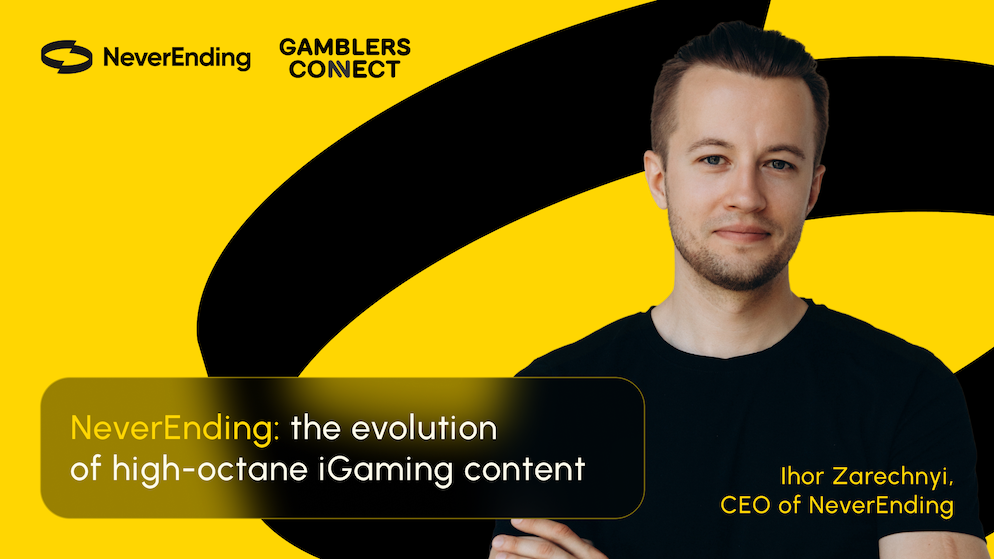
For years, the iGaming sector has navigated through “market blindness,” relying on legacy production cycles and bureaucratic overhead to measure success. NeverEnding is changing that reality. Built on a foundational “B2B backed by B2C power” philosophy, the studio utilizes rapid execution to transform traditional game development into a singular, undeniable driver of player engagement. Now, Founder and CEO Ihor Zarechnyi is applying this rigorous efficiency to industry standards.
NeverEnding rejects the traditional, slow-moving studio model, replacing industry red tape with technological stability and market-driven mechanics to deliver content based solely on verifiable demand. In this exclusive discussion, Zarechnyi explains how NeverEnding is moving the industry from guesswork to precision, ensuring that true operational excellence, not budget size, defines the winners of tomorrow.
PHILOSOPHY & ORIGIN
The “No Excuses” Genesis
The iGaming industry has historically operated with a significant blind spot: fragmented development cycles and often subjective game design. Founded by Ihor Zarechnyi, NeverEnding was built on the philosophy that operators and stakeholders deserve a “high-octane” partner. By stripping away industry red tape, NeverEnding replaces bureaucracy with quick execution and technological stability. This shifts the industry from manual estimation to content-driven precision, solving the chronic problem of opaque player dynamics.
Q: Ihor, NeverEnding was born from a frustration with the industry’s lack of clarity and speed. Can you take us back to the moment you realized existing studio models weren’t enough, and how that realization drove the core philosophy of “Games, Growth, and No Excuses” that defines NeverEnding today?
Ihor Zarechnyi: It wasn’t one single moment, it was a pattern. Providers promising innovation, delivering average, and then blaming timelines or “market conditions” when things underperform. I spent more time managing the limitations of studios and partners than actually building something meaningful. The conversations were always the same — “it’s coming soon,” “it’s on the roadmap.” But the roadmap never arrived anywhere. So I asked a simple question: what if we just removed every excuse from the equation?
That’s where NeverEnding started. We own the full product pipeline — from concept to math to art to integration, so we can look any operator in the eye and say, “here, let me show you this working right now.”
“Games, Growth, and No Excuses.” is not a tagline someone pitched to us. That’s literally just the job. Make good games. Grow. And if something’s not working — fix it, don’t PowerPoint it.
Solving the “Red Tape” Blindness
Before NeverEnding, high-level game development was a luxury reserved for legacy studios with massive, slow-moving departments. NeverEnding democratized this by creating a unified ecosystem where complex mechanics and rapid deployment are accessible to all. This levels the playing field, allowing emerging brands to see exactly where they stand against giants and understanding why, whether it’s a spike in engagement or a highly effective acquisition strategy.
Q: You’ve effectively democratized access to high-level game development. What specific problem does this solve for the industry, particularly for agile challengers trying to compete with established giants?
Ihor Zarechnyi: Most providers compete on volume. Hundreds of games a year, most of them landing the same way. We’re small and that’s the point. Every game we ship has to perform because we don’t have filler to fall back on.
What that gives operators is a direct line to the people who actually built the product. No account managers relaying messages to a dev team three countries away. Something’s off — we fix it together. That kind of loop doesn’t exist with the big guys. Their scale won’t allow it. Our scale demands it.
Beyond Traditional Production
Traditional tools often rely on safe, repetitive titles or limited internal playtesting, which are increasingly unreliable in a fast-moving market. NeverEnding bypasses this by using a “B2B backed by B2C power” approach to analyze real player sentiment and market traction at scale. This provides a holistic view of engagement that internal corporate data simply cannot capture.
Q: Most operators are used to looking at their own internal data or limited panel-based reports. Why is NeverEnding’s ‘B2C-backed’ approach, utilizing real-time engagement and technological stability, superior for understanding true market demand compared to these traditional methods?
Ihor Zarechnyi: The industry standard is reactive: build a game, ship it, wait for an operator’s report to tell you how it performed. By the time that feedback arrives, it’s already old. We built our infrastructure around real-time data from day one. Across every operator we work with, we’re tracking how players actually behave, not aggregated summaries, but live engagement patterns that tell us exactly where a game delivers and where it doesn’t.
That gives us something most providers don’t have: the ability to iterate fast and with precision. Our integration architecture was designed for this — stable enough to handle real-time data flow, flexible enough to act on it immediately. When we say a game is market-tested, we mean it’s been validated against real player behavior, not an internal focus group.
Q: How do you back-test your methodology? Have there been cases where the data said one thing and the market did the opposite?
Ihor Zarechnyi: We back-test by comparing pre-launch data signals against actual post-launch performance across every market we’re live in. Math models, session behavior, volatility preferences — we track all of it and measure how closely our predictions matched reality. It’s not theoretical. Every game we release becomes a data point that either validates or challenges our assumptions.
And yes, the data has been wrong. We’ve had cases where everything pointed to a mechanic performing well — and it didn’t. The difference is what you do with that. Most providers bury it and move on to the next release. We treat it as the most valuable feedback we can get. When the market surprises you, that’s not a failure of the model — that’s the model getting smarter. The worst thing you can do in this industry is fall in love with your own data and ignore what players are actually telling you.
Q: Do you benchmark your predictions against any external data source to validate accuracy?
Ihor Zarechnyi: We benchmark against the only source that actually matters: real player behavior post-launch. External reports and panel data have their place, but they’re snapshots of the past averaged across hundreds of providers. That’s useful for trend-spotting, not for validating whether a specific mechanic will work in a specific market.
Our approach is simpler: we build a model, we launch, we compare. Where the prediction held — we reinforce it. Where it didn’t — we dig into why. Every operator we work with adds another layer of validation data. That compounds over time into something no third-party benchmark can offer — a feedback loop that’s specific to our games, our mechanics, and the markets we’re actually in.
THE NEVERENDING ECOSYSTEM
B2C Power as the Sole Jury
The industry is saturated with content often criticized for being “corporate-first” and slowed by subjective opinions. NeverEnding represents a radical paradigm shift: “B2C is the Jury”. Success is not chosen by a corporate panel in a closed room; it is shown by the market. By leveraging Zarechnyi’s performance-driven background, the studio eliminates bias entirely, recognizing market traction based solely on player demand and technological stability.
Q: NeverEnding is positioned as an “anti-bureaucracy” studio, effectively removing corporate red tape. How did you come up with the idea to pivot from pure commercial roles to an independent studio, and what are you doing differently than the traditional developers?
Ihor Zarechnyi: I spent enough years on the commercial side to know exactly where the industry wastes time. It’s not talent: there are brilliant people at every major provider. It’s structure. Every decision runs through layers of people who don’t build the product but get to slow it down. The “pivot” wasn’t some grand strategic moment, it was frustration reaching a tipping point. I knew what operators actually needed, I knew what was taking too long, and I knew it didn’t have to be that way.
So we built NeverEnding around one idea: if it doesn’t help us ship better games faster, it doesn’t exist here. No sprint committees. No approval chains. Our integration team runs on Kanban — a partner raises an issue, we fix it in real time, not next cycle. Our CTO is in direct contact with partners, not hidden behind three layers of project management. The result is 5-day integrations and same-day decisions. Not because we cut corners, but because we never built the bureaucracy that creates the corners in the first place.
Q: You mention engagement stability — what’s the actual metric? Session length, return rate, bet frequency, something composite?
Ihor Zarechnyi: There’s no single number that tells you a game is working. Session length, return rate, bet frequency — they all matter, but only in context. A long session with no return visits means the game burned the player out. A high return rate with shrinking bet sizes means interest is fading. What we track is how these metrics move relative to each other. If they’re all holding or growing together — that’s stability. If one spikes while the others dip, something’s off and we dig into it.
We deliberately don’t wrap it into one composite score. The moment you do that, you lose the detail that actually tells you what to fix. Our partners get the breakdown, not a dashboard number that looks good in a report but tells you nothing about what’s happening inside the game.
Q: How do you adjust for market differences? Does a mechanic performing well in LatAm get scored differently than the same mechanic in Northern Europe?
Ihor Zarechnyi: Absolutely! and this is where a lot of providers get it wrong. They build one game, ship it globally, and call it a day. Then they’re surprised when something that crushed it in Brazil barely registers in Sweden. Player behavior is not universal. Volatility preferences, session patterns, mechanic engagement — all of it shifts depending on the market. A feature that drives retention in LatAm might feel irrelevant in Northern Europe, not because the game is bad, but because the players want different things.
So yes, we score differently by market. Same mechanic, different context, different weight. That’s not complexity for the sake of it: it’s the minimum you need to do if you actually want to build games that perform rather than games that just exist in a lobby. Our architecture supports this because it was designed to handle that granularity from day one. We’re not retrofitting regional logic onto a one-size-fits-all engine.
Evolution from Studio to Strategic Pillar
The transition from a pure content creator to a strategic industry pillar was a natural evolution for NeverEnding. By continuously tracking the heartbeat of the industry and monitoring fluctuations in player interest, NeverEnding essentially runs a 24/7/365 optimization loop. This evolution highlights how NeverEnding isn’t just a passive observer, but an active arbiter of commercial success.
Q: Your studio seems to be a natural extension of your performance-driven philosophy. How did the platform evolve to support this, and why do you believe the industry is finally ready to accept content chosen by B2C signals rather than a panel of peers?
Ihor Zarechnyi: The platform wasn’t retrofitted, it was built so that live performance data feeds directly into development. A game launches, signals come back, and those signals shape what we build next. Development and performance aren’t separate phases here, they’re the same loop.
Is the industry ready for this? It doesn’t have a choice. Lobbies are drowning in games that passed the same committee checklist and look identical. Players don’t care who approved the game, they care if it holds their attention. The old model isn’t being replaced because something better came along. It’s being replaced because it stopped working.
Q: What’s your hit rate — of the trends you’ve identified early, what percentage actually scaled?
Ihor Zarechnyi: Not every trend we spot early turns into something. That’s the honest answer. But the goal was never a perfect hit rate but the system. We test fast, measure fast, and kill what doesn’t work before it becomes a six-month development cycle with nothing to show for it. So the misses are cheap. The wins are the ones we’ve validated with real data before going all in.
If I had to put a number on it, the mechanics and trends we’ve fully committed to have landed significantly above market average in terms of performance. But that’s partly by design. We don’t commit until the data gives us a reason to. It’s validation with speed.
Differentiation Factor
Many industry providers have overlapping categories that can be vague. NeverEnding differentiates by aligning its content with specific, measurable KPIs. Titles that speak directly to the operational goals of C-level executives—such as retention and acquisition efficiency, make the integration a validation of business strategy rather than just a library update.
Q: Traditional providers often have broad, subjective categories. How do the specific mechanics in NeverEnding’s games reflect the real operational KPIs that C-level executives care about, effectively turning each launch into a validation of business strategy?
Ihor Zarechnyi: “Popular” and “feature-rich” don’t mean anything on a P&L. We build mechanics around specific KPIs: retention, session value, return behavior, bet frequency. Each launch is designed so the operator can draw a straight line from game performance to a number on their board deck.
That makes every release a business case, not just content. It either validates the strategy or shows exactly where to adjust. Most providers can’t offer that because their games weren’t built with operational metrics in mind. We’d rather skip the pitch deck and show you the data.
Q: What does “technological robustness” mean in measurable terms — uptime percentage, load capacity, latency benchmarks?
Ihor Zarechnyi: For us it means three things. First, sub-500ms total latency per spin — that includes bet processing, win calculation, and response. Anything above that and the player feels it, especially in turbo mode. Second, our platform handles integrations with minimal code, which means fewer failure points and faster recovery when something does break. Third, our architecture was built clean from day one: no legacy patches, no duct-taped systems acquired over a decade. That alone eliminates half the stability issues most providers deal with.
Uptime targets and load capacity matter, but they’re table stakes, everyone claims 99.9%. What actually separates robust from fragile is how the system behaves under real conditions: a partner’s wallet responding slowly, a regulatory requirement landing mid-sprint, a new market going live. Our system was designed to absorb that without everything downstream breaking.
METHODOLOGY & INTEGRITY
The Selection Mechanics
A key differentiator for NeverEnding is the transparency and complexity of its development methodology. Success is determined by standardized metrics such as engagement stability and technological robustness. For example, the “Fastest-Scaling Title” isn’t a guess; it’s calculated from the largest year-over-year growth in verifiable player demand.
Q: Let’s dig into the mechanics. How exactly are your games developed? How do you weigh different metrics to ensure that the content captures the nuance of different market strategies?
Ihor Zarechnyi: Math first. Before anyone opens a design tool, we know which mechanics are performing: session behavior, return patterns, bet frequency. That data shapes the game. Everything else: visuals, UX, sound, gets built around a core that’s already proven to work. Sounds obvious, but most studios still start with a theme and hope the numbers show up later.
Then we layer in market context. Volatility appetite in LatAm isn’t the same as in the Nordics. Session expectations differ. Bonus sensitivity differs. So we weight and configure mechanics per region, it’s flexible architecture that lets us tune the same product for different audiences without starting from scratch.
Q: What weight does each metric carry? Is it 50/30/20, or does it shift by market?
Ihor Zarechnyi: No fixed ratio. The whole point is that it moves. Bet frequency might lead in one region, session depth in another. We start with a baseline per market and let live data rebalance it.
The moment you hardcode a split and apply it everywhere, you stop listening. Our platform is built to adjust weightings as signals come in, not three months later in a product review.
Identifying True Innovation
One of the most powerful capabilities of NeverEnding is its ability to spot “rising trends” before the rest of the market does. The studio leverages this to recognize not just established giants, but also breakout mechanics that have shown exceptional efficiency. By relying on B2C trends, NeverEnding can identify what out-performs the expected baseline, highlighting true operational excellence rather than just budget size.
Q: Traditional studios often favor legacy brands with the deepest pockets. How does your methodology ensure that a smaller, hyper-efficient operator who is massively over-performing their baseline gets recognized alongside the industry giants?
Ihor Zarechnyi: Performance is performance. Our system shows a smaller operator crushing their baseline the same way it shows anyone else. No logo hierarchy, no priority tiers based on spend.
We’re built lean ourselves. Direct relationships, no enterprise sales layers. That means a hyper-efficient operator gets the same access and response time as the biggest name in our portfolio. If the numbers are there, we show up.
Q: Can you share a specific case where your methodology surfaced a smaller operator or mechanic that the industry overlooked? What were the numbers before and after?
Ihor Zarechnyi: Early in our rollout, a partner in Eastern Europe, roughly 5,000 monthly active players, integrated our titles into a lobby of about 800 games from established providers. Standard setup, nothing tailored. Within the first 45 days, one title was generating 3.8% of their slot GGR, where a typical new game from a known provider would sit at 1 to 1.5% in the same timeframe.
The deeper numbers told the real story. Sessions on that game averaged 20 minutes against a 14-minute lobby average. Day-7 retention hit 13%, versus their platform baseline of 8%. The operator had never seen a title from a provider our size break into their top 10 performers that fast. No promotional spend behind it, no featured lobby placement. Players found it and stayed.
That mechanic is now built into our next wave of titles. Not because we thought it was clever, but because a 5,000-player operator proved it worked before anyone else noticed.
Q: What’s the threshold for “over-performing baseline” — is it 2x, 5x? How do you define the baseline itself?
Ihor Zarechnyi: Baseline is simple. We take the operator’s average game performance across their lobby: GGR contribution per title, session length, and day-7 return rate. That’s the benchmark. Not an industry average from a report, not a theoretical number. Their actual data, their actual players.
Over-performing starts at 2x on any single metric. But what we really look for is when multiple metrics move together. A game doing 2x on GGR contribution alone could just mean good lobby placement. A game doing 1.8x on GGR, 1.5x on session length, and 1.7x on return rate simultaneously, that’s a real signal. In our experience, when a title crosses 2x on two or more core metrics against the operator’s own baseline, it’s outperforming in a way that’s sustainable, not just a launch spike.
Ensuring Integrity
With player demand being the sole judge, the integrity of that data is paramount. NeverEnding employs rigorous cleaning protocols to ensure that the metrics driving the studio cannot be manipulated. This commitment to “clean performance” ensures that the games truly reflect genuine player interest and market stability.
Q: Since your model is entirely data-dependent, how do you protect the integrity of the results against potential manipulation intended to game the system?
Ihor Zarechnyi: Any data-driven model has this risk, and pretending otherwise would be naive. The short answer is: we validate at multiple levels. No single data point drives a decision. When we see a mechanic outperforming, we don’t act on one operator’s numbers. We look for the same pattern across multiple partner environments, different player bases, different markets. If it only shows up in one place, it’s an anomaly, not a signal.
On the technical side, our architecture is built to flag inconsistencies. Unusual spikes in session behavior, irregular bet patterns, sudden shifts in return rates that don’t correlate with anything else. These get isolated and reviewed before they enter any product decision. The system doesn’t just collect data, it questions it. That’s the difference between being data-driven and being data-naive.
STRATEGIC VISION & FUTURE
The 2026 Roadmap
Looking ahead to 2026, NeverEnding is set to expand the depth of its intelligence even further. The roadmap includes the introduction of deeper “Player Profiles” and “Marketing Mix Analytics,” moving beyond what happened to who played and how. The 2026 strategy will likely incorporate these granular insights, offering content that recognizes excellence in specific player segmentation and retention.
Q: As we look toward 2026, what is the future of NeverEnding? How will features like deeper Player Profiles shape the next iteration of your content?
Ihor Zarechnyi: The 2026 roadmap is built around two things: mechanic expansion backed by data, and giving operators smarter tools to act on what that data shows. On the product side, we’re shipping 40+ titles through the year, progressively broadening from our core Hold & Win mechanics. That’s not diversification for the sake of it. Each new mechanic enters the pipeline because player data from earlier releases justified it.
The deeper shift is on the analytics side. Player Profiles will let us segment beyond basic engagement into behavioral patterns: how different player types interact with specific mechanics, where sessions strengthen or fade, what triggers return visits. For us, it means every title we build in 2026 is more targeted than the last. For our partners, it means they stop guessing and start making decisions backed by mechanic-level player intelligence.
Defining the Industry Standard
NeverEnding’s long-term vision extends beyond just reporting data; it aims to set the standard for iGaming performance. By 2026 and onwards, the goal is for the NeverEnding model to become the definitive benchmark for the sector. This shifts the paradigm to a future where operators optimize for speed and stability to prove their operational health, cementing speed and technological stability as the ultimate currency of the industry.
Q: Your vision seems to be for NeverEnding to become the definitive benchmark for the entire industry. Beyond 2026, how do you see your role evolving from a content provider to a central institution that dictates how value and success are defined in the global gaming market?
Ihor Zarechnyi: I wouldn’t use the word “dictate.” That’s exactly the kind of thinking we’re trying to move away from. The industry doesn’t need another company telling everyone how things should work. It needs proof that a different approach actually delivers. That’s what we focus on. If our model becomes a benchmark, it won’t be because we declared it one. It will be because the results made it impossible to argue with.
Beyond 2026, I see NeverEnding evolving from a studio that builds games into a studio that sets the standard for how games should be built. Not through market share or volume, but through methodology. When operators start expecting real-time performance validation, mechanic-level analytics, and five-day integrations as a baseline from every provider, that’s when you know the benchmark shifted. We want to be the reason that bar moved, not the company standing on stage claiming credit for it.