

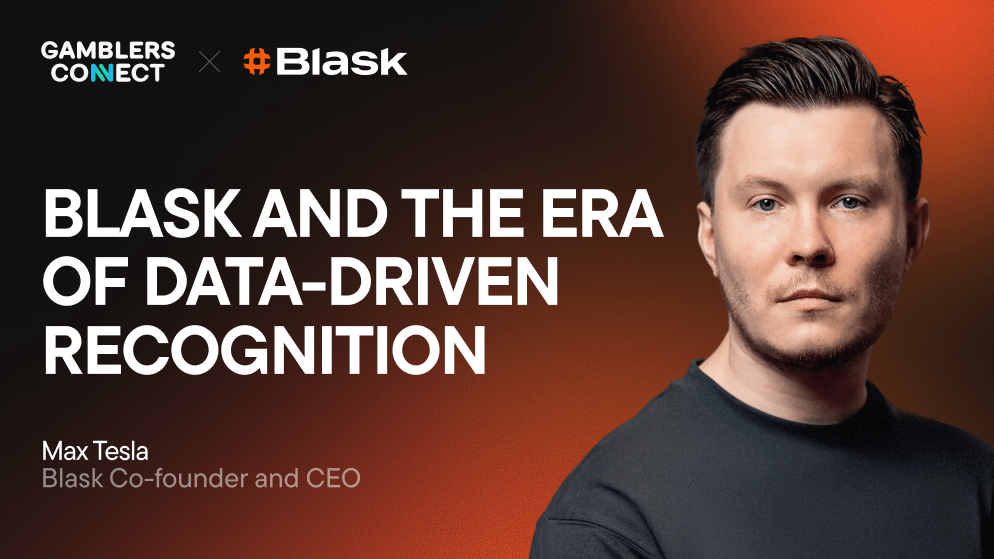
For years, the iGaming sector has navigated through “market blindness,” relying on lagged reports and subjective opinions to measure success. Blask is changing that reality. Built on a foundational “Truth in Data” philosophy, the platform utilizes advanced AI to transform fragmented public signals into a singular, undeniable view of market performance via the Blask Index. Now, Co-founder Max Tesla is applying this rigorous transparency to industry accolades.
The Blask Awards reject the traditional submission-based model, replacing human panels with hard numbers to crown winners based solely on verifiable demand and growth. In this exclusive discussion, Tesla explains how Blask is moving the industry from guesswork to precision, ensuring that true operational excellence, not budget size, defines the winners of tomorrow.
PHILOSOPHY & ORIGIN
The “Truth in Data” Genesis
The iGaming industry has historically operated with a significant blind spot: fragmented, delayed, and often subjective market intelligence. Founded by Max Tesla, Blask was built on the philosophy that operators and stakeholders deserve a “single source of truth.” By utilizing advanced Computer Vision and Natural Language Processing, Blask replaces guesswork with the “Blask Index”, a real-time, Nasdaq-style gauge of brand demand and market share updated hourly.
This shifts the industry from manual estimation to AI-driven precision, solving the chronic problem of opaque market dynamics, something that can be best reflected in Blask’s revolutionary Awards.
Q: Max, Blask was born from a frustration with the industry’s lack of clarity. Can you take us back to the moment you realized existing analytics tools weren’t enough, and how that realization drove the core philosophy of “Truth in Data” that defines Blask today?
Max Tesla: Blask started from a very simple frustration: in an industry driven by numbers, there was surprisingly little you could treat as a reliable baseline. Teams were expected to plan growth, enter new markets, and defend budgets — but decisions often leaned on assumptions, partial datasets, or tools that captured activity without explaining.
That’s the gap we set out to close. We focus on turning fragmented market signals into structured, comparable benchmarks that teams can use to validate decisions, spot momentum early, and plan with more confidence.
For me, “Truth in Data” means one thing: less guessing, more clarity. Data that does not just describe what is visible – but helps explain what is changing, and where attention is moving next.
Solving the “Market Blindness”
Before Blask, high-level market intelligence was a luxury reserved for tier-1 operators with massive Business Intelligence departments. Blask democratized this by creating a unified ecosystem where complex metrics like the Acquisition Power Score (APS) and Brand’s Accumulated Power (BAP) are accessible to all. This levels the playing field, allowing emerging brands to see exactly where they stand against giants and understanding why, whether it’s a spike in organic search or a highly effective retention strategy.
Q: You’ve effectively democratized access to high-level market intelligence. What specific problem does this solve for the industry, particularly for agile challengers trying to compete with established giants?
Max Tesla: For a long time, big budgets and big teams didn’t guarantee good decisions. Money was often spent faster than understanding was built – and scale just amplified mistakes.
What Blask changes is not the promise of guaranteed success. That does not exist in iGaming. What it changes is probability. When more teams can reference the same market benchmarks, advantage shifts away from who can spend more, and toward who can act earlier and more precisely.
You still need execution, product, and distribution. But when timing and market selection are driven by clearer signals of demand, challengers get a fairer shot at competing with incumbents.
Beyond Traditional Analytics
Traditional tools often rely on cookies or limited user panels, which are increasingly unreliable due to privacy regulations. Blask bypasses this by using AI to analyze public data signals, search intent, brand mentions, and player sentiment, at scale. This “outside-in” approach provides a holistic view of market share that internal data simply cannot capture.
Q: Most operators are used to looking at their own internal data or limited panel-based reports. Why is Blask’s ‘outside-in’ approach, utilizing AI and public data signals, superior for understanding true market share compared to these traditional methods?
Max Tesla: Internal data only tells you how you perform inside your own echo chamber. Panels can add context, but they are still a limited and often delayed echo of reality.
Blask looks from the outside in. By organizing large-scale public demand signals with machine learning, we can observe shifts in attention before they show up as traffic, sign ups, or revenue in internal reporting.
This does not replace internal measurement, it completes it. It also helps team understand where demand is forming, how interest is moving across brands, and what competitive positioning looks like in context. That’s where better strategic decisions start.
THE BLASK AWARDS ECOSYSTEM
Data as the Sole Jury
The industry is saturated with awards ceremonies often criticized for subjective judging panels and “pay-to-play” mechanics. The Blask Awards represent a radical paradigm shift: “Data is the Jury.” Winners are not chosen by a panel in a closed room; they are shown by the data. By leveraging the platform’s massive dataset, the awards eliminate human bias entirely, recognizing winners based solely on audit-able metrics like the highest BAP or best Baseline Breakout performance.
Q: The Blask Awards are positioned as the first “data-driven” accolades in the sector, effectively removing the human jury. How did you come up with the idea to pivot from pure analytics to an awards body, and what are you doing differently than the traditional awards circuit?
Max Tesla: Traditional awards often depend on submissions, juries, and subjective evaluation. That does not make them “wrong”, but it does make outcomes inconsistent and difficult to compare year to year.
The Blask Awards remove that layer. There are no applications – only criteria derived from our benchmarks. The idea came naturally from what we already do: we track demand continuously, so the question was simple – if data can guide hi-stakes decisions, it can also support recognition.
We don’t reward who tells the best story. We recognize what the market validates through sustained demand, momentum, and measurable performance signals. In that sense, the Blask Awards aren’t a departure from our work – they are an extension of it.
Evolution from Index to Accolade
The transition from a pure analytics tool to an awards body was a natural evolution of the Blask Index. By continuously tracking the heartbeat of the industry, monitoring fluctuations in brand interest and market share hourly, Blask essentially runs a 24/7/365 competition. The awards are simply a snapshot of this continuous race. This evolution highlights how Blask isn’t just a passive observer, but an active arbiter of success.
Q: The awards seem to be a natural extension of your core product. How did the platform evolve to support this, and why do you believe the industry is finally ready to accept an award winner chosen by an algorithm rather than a panel of peers?
Max Tesla: The platform didn’t evolve for the awards – the awards became possible because the platform matured, and because the industry is increasingly asking for benchmarks that are easier to reference internally.
It’s less about trusting algorithms and more about trusting criteria. iGaming is too competitive, too global, and too fast-moving for recognition based purely on subjective opinion to carry the same operational weight.
An algorithm does not replace human judgement – it reduces subjectivity. And when recognition reflects what the market rewards through observable signals, teams are more willing to treat it as a meaningful benchmark and not just a PR moment.
Differentiation Factor
Many industry awards have overlapping categories that can be vague, such as “Best Casino.” Blask differentiates by aligning its categories with specific, measurable KPIs. Awards like “Relative Market Share Excellence” or “Highest Retention Signal” speak directly to the operational goals of C-level executives, making the trophy a validation of business strategy rather than just a PR win.
Q: Traditional awards often have broad, subjective categories. How do the specific categories in the Blask Awards reflect the real operational KPIs that C-level executives care about, effectively turning the award into a validation of business strategy?
Max Tesla: Traditional categories are often designed for storytelling. Ours are designed for decision-making.
Blask Awards categories map to measurable outcomes: demand growth (via the Blask Index), momentum, consistency over time, and competitive positioning within a specific market segment or geography. Each category is tied to a benchmark, not a campaign narrative or a one-off activation.
That’s what makes it useful for leadership teams. It’s not only prestige – it’s an external, data-backed signal that a strategy is translating into observable market movement.
METHODOLOGY & INTEGRITY
The Selection Mechanics
A key differentiator for the Blask Awards is the transparency and complexity of its methodology. Winners are determined by standardized metrics such as the Acquisition Power Score (APS), which measures how effectively a brand converts visibility into new customers, and the Competitive Earning Baseline (CEB), which projects realistic revenue potential. For example, the “Fastest-Growing Brand” isn’t a guess; it’s calculated from the largest year-over-year growth in Brand’s Accumulated Power (BAP).
Q: Let’s dig into the mechanics. How exactly are the award winners chosen? How do you weigh different metrics like BAP versus APS to ensure that the recognition is fair and captures the nuance of different market strategies?
Max Tesla: The principle is simple, but execution is rigorous: we look at market behavior across multiple signals over time.
BAP reflects long-term brand strength — consistency of accumulated demand and competitive relevance.
APS captures acquisition potential – how effectively attention translates into acquisition outcomes as a baseline.
CEB provides context – the revenue baseline a brand should be able to capture in a market given its market-driven position and conditions.
Different categories emphasize different benchmarks depending on the strategic outcome. Some highlight sustained brand leadership (weighted toward BAP). Others highlight breakout momentum or efficiency (weighted toward APS and relative performance vs baseline).
Fairness comes from consistency: the same criteria apply across the market, without submissions or subjective scoring. The point is not to declare absolute truth, but to provide a comparable benchmark for recognition
Identifying True Innovation
One of the most powerful capabilities of Blask’s AI is its ability to spot “rising stars” before the rest of the market does. The awards leverage this to recognize not just established giants, but also breakout brands that have shown exceptional efficiency. By relying on data like the Blask Index growth trends, Blask can identify a smaller operator who outperformed their expected baseline by a massive margin, highlighting true operational excellence rather than just budget size.
Q: Traditional awards often favor the incumbents with the deepest pockets. How does your methodology ensure that a smaller, hyper-efficient operator who is massively over-performing their baseline gets recognized alongside the industry giants?
Max Tesla: Traditional awards often reward size and visibility rather than performance. Our methodology flips that logic. By combining BAP, APS, and CEB, we measure not just absolute presence, but efficiency relative to the market. A smaller operator that is massively over-performing its competitive baseline is just as visible in the data as a giant brand — sometimes even more so. This ensures recognition goes to real market impact, not budgets. Success is measured by results achieved, not resources spent, giving hyper-efficient challengers a fair shot alongside incumbents.
Looking ahead, we plan to expand the number of award categories, so recognition won’t be limited to the big brands everyone already knows — more operators, of all sizes, will have a chance to be highlighted for their real market performance.
Ensuring Data Integrity
With data being the sole judge, the integrity of that data is paramount. Blask employs rigorous cleaning protocols to ensure that the metrics driving the awards cannot be manipulated by bot traffic or artificial search spikes. This commitment to “clean data” ensures that the winners are truly reflecting genuine player interest and market performance.
Q: Since the awards are entirely data-dependent, how do you protect the integrity of the results against potential manipulation, such as bot traffic or artificial spikes in search volume intended to game the system?
Answer: Our core approach is demand-based: we track brand-related signals and build the Blask Index as a leading indicator of shifts in interest and positioning.
To reduce distortion, we measure brands, not domain names. Mirrors, clones, and aliases are consolidated into a single profile. We also filter signals by intent to reduce noise that doesn’t reflect real demand.
On manipulation: we use anomaly detection to flag patterns that look inconsistent with market reality – for example, sudden surges without seasonal context, without peer movement, or with abnormal signal structure. Flagged cases go through a defined review protocol:
- verify consolidation and brand mapping,
- validate signal mix and geographic consistency,
- check for known seasonal/calendar drivers,
- compare with competitor cluster behavior,
- decide whether to exclude or down-weight the anomaly window.
That combination with automated detection plus structured review, protects the integrity of the benchmark without pretending the world is perfectly clean.
STRATEGIC VISION & FUTURE
The 2026 Roadmap
Looking ahead to 2026, Blask is set to expand the depth of its intelligence even further. The roadmap includes the introduction of deeper “Customer Profiles” and “Marketing Mix Analytics,” moving beyond what happened to who did it and how. The 2026 Blask Awards will likely incorporate these granular player-level insights, offering categories that recognize excellence in specific player segmentation and retention strategies.
Q: As we look toward 2026, what is the future of Blask? How will features like deeper Customer Profiles shape the next iteration of the Blask Awards?
Max Tesla: The future of Blask is about expanding depth and reach – and making market movement easier to interpret.
We’re building more explanatory layers, including Market Explanation, so teams can understand the “why” behind shifts. We’re also improving product-level scoring and expanding coverage across more geographies.
Over time, this will make the Blask Awards more granular and more useful, not just “who won,” but what kind of performance won, in what context, and why it matters. The goal stays simple: recognition that reflects real market movement and strategy, not presentation.
Defining the Industry Standard
Blask’s long-term vision extends beyond just reporting data; it aims to set the standard for iGaming performance. By 2026 and onwards, the goal is for the Blask Index to become the definitive benchmark, the “S&P 500” of iGaming. This shifts the paradigm to a future where operators optimize for Blask metrics to prove their valuation and operational health to investors, cementing data as the ultimate currency of the industry.
Q: Your vision seems to be for the Blask Index to become the definitive benchmark for the entire industry. Beyond 2026, how do you see the role of Blask evolving from an analytics provider to a central institution that dictates how value and success are defined in the global gaming market?
Max Tesla: Our vision isn’t to become a gatekeeper. It’s to make the market more visible and more comparable.
iGaming has long operated with partial information and assumptions. We’re building benchmarks that help teams interpret demand, positioning, and momentum across markets, so decisions can be grounded in clearer signals rather than guesswork.
Over time, I expect Blask to play a role in standardization – not “dictating success,” but helping the industry speak a more consistent language about performance. More transparency, better comparability, and better decision-making. That’s the mission.