
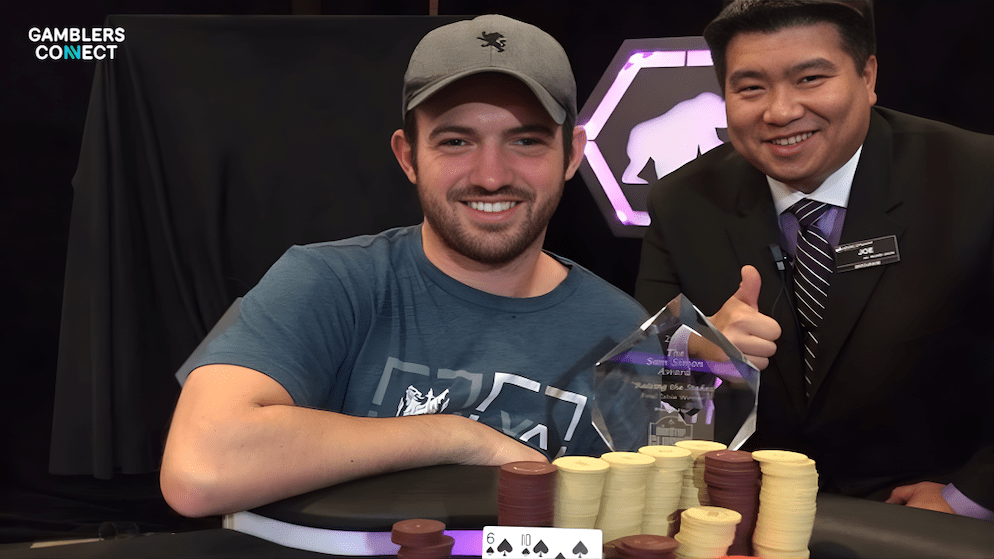
In the high-variance world of professional poker, few names command the unique mixture of historical significance and modern respect as Joe Cada. While many know him as the record-breaking “boy wonder” who took down the 2009 World Series of Poker (WSOP) Main Event, his career is far more than a single lightning strike of good fortune. It is a masterclass in longevity, adaptation, and mathematical precision.
This guide delves into the life, strategy, and enduring legacy of the man known as “The Kid,” offering a complete picture of Joe Cada poker mastery for fans and aspiring pros alike.
1. Early Life: The Dealer’s Son
Born on November 18, 1987, in Shelby Charter Township, Michigan, Joseph Cada was effectively born into the world of cards. His mother, Ann, was a blackjack dealer at the MotorCity Casino in Detroit, giving Joe an early, unvarnished look at the gambling industry. Unlike many pros who discovered the game in college dorms, Cada’s education began at the kitchen table and transitioned to the digital felt by age 16.
Before he could legally step foot on a casino floor in the United States, Cada was already a veteran of the virtual high-stakes world. Playing under the alias jcada99, he grinded cash games and tournaments, building a bankroll that would eventually fuel his live career. Because he couldn’t play in Vegas, he spent his weekends traveling across the border to Windsor, Ontario, Canada, where the legal gambling age was 19, sharpening his live skills long before his peers.
2. The Historic 2009 Run: A Record-Breaking Victory
The Joe Cada WSOP narrative truly began in the summer of 2009. At 21 years and 11 months old, Cada arrived in Las Vegas for his first-ever World Series of Poker eligible to play the Main Event.
The Path to the November Nine
Navigating a field of 6,494 players, Cada displayed a maturity beyond his years. However, his journey was famously volatile. He was backed by professional players Cliff “JohnnyBax” Josephy and Eric Haber, a common practice where investors put up the buy-in (in this case, $10,000) in exchange for a percentage of the winnings. This financial safety net allowed Cada to play aggressively without “scared money.”
The Final Table
Entering the “November Nine” (the delayed final table format used at the time), Cada was not the chip leader. He famously had to survive a harrowing coin flip with pocket threes against pocket jacks to stay alive. In the end, he found himself heads-up against Darvin Moon, a logger from Maryland who represented the “everyman” amateur.
On November 10, 2009, holding a pair of nines against Moon’s Queen-Jack, Cada’s hand held up. He claimed the title, the bracelet, and the $8.55 million top prize. In doing so, he eclipsed Peter Eastgate’s record to become the youngest champion in history, a record that still stands today.
3. “The Luckbox” Narrative vs. Mathematical Reality
Following his win, poker Joe Cada faced a wave of criticism from purists who labeled him a “luckbox.” Critics pointed to the variance he survived at the final table and his high-variance pushing style. However, this criticism fundamentally misunderstood Cada’s approach.
Cada was a pioneer of the “math-based” aggression that would come to dominate the game in the 2010s. While older pros waited for “feeling” and “reads,” Cada was calculating equity ranges and shoving light to exploit tight players. His victory wasn’t an accident; it was a changing of the guard. He spent the next decade proving this, not with words, but with results.
4. The 2018 Redemption: Silencing the Doubters
If 2009 was about youthful exuberance, 2018 was about undeniable greatness. Nearly a decade after his world championship, the Joe Cada Main Event story added a miraculous chapter.
In the modern era, with field sizes exploding, it is statistically improbable for a former champion to return to the Main Event final table. Yet, in 2018, Cada navigated a massive field of 7,874 players to finish 5th, earning $2.15 million. This feat made him the first Main Event winner since Dan Harrington (1995 champ, 2003/2004 finalist) to return to the final table.
That same summer, he won two bracelets:
- Event #3: $3,000 No-Limit Hold’em Shootout ($226,218)
- Event #75: $1,500 “The Closer” ($612,886)
This performance ended any lingering debates about his skill level. He wasn’t just a lucky kid; he was one of the best tournament closers in the world.
5. Joe Cada Net Worth and Earnings Profile
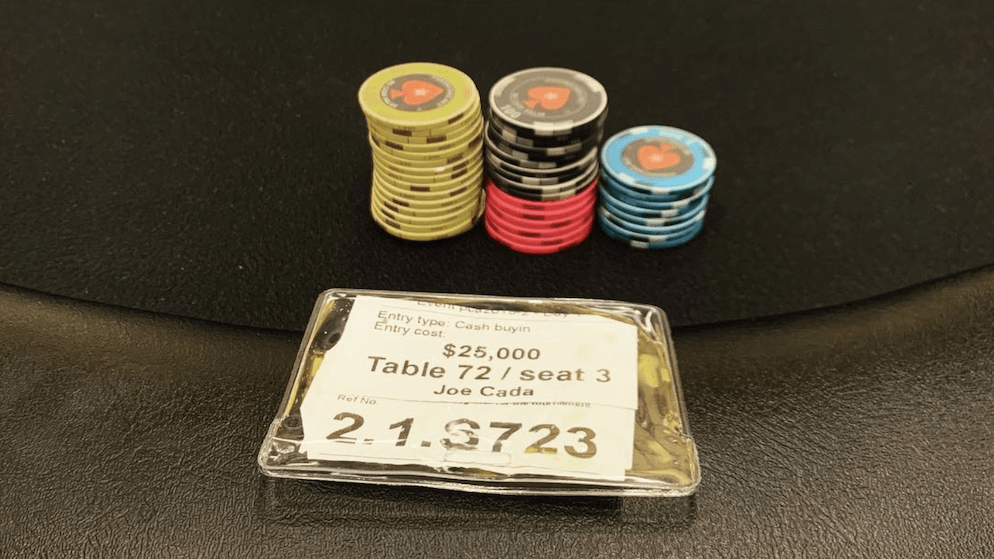
Analyzing the Joe Cada net worth requires looking beyond just the headline numbers. While Hendon Mob lists his total live earnings at over $14.7 million as of early 2026, his actual net worth is a complex calculation of wins, backing deals, and taxes.
Key Financial Factors:
- The 2009 Split: Because he was backed by Cliff Josephy and Eric Haber, approximately 50% of his $8.55 million Main Event win went to his backers.
- Taxes: As a US resident, a significant portion of his winnings is subject to federal and state taxes.
- Sponsorships: Following his 2009 win, Cada signed a lucrative deal with PokerStars, which provided a steady income stream for several years.
- Business Ventures: Cada has invested in real estate and famously opened a bar/restaurant in his hometown, diversifying his income away from the felt.
Estimated Net Worth (2026): Conservative estimates place his personal net worth in the $10 million to $12 millionrange, accounting for career longevity, investment growth, and retained earnings from his post-2009 successes where he likely played with 100% of his own action.
6. Joe Cada vs. The High Rollers: A Comparative Analysis
In the current era of Super High Rollers, the poker landscape is dominated by players who specialize in small-field, massive buy-in events. A prime example is the German pro Christoph Vogelsang. While Cada represents the pinnacle of large-field WSOP success, Vogelsang represents the GTO (Game Theory Optimal) laboratory style of the Triton and Super High Roller Bowl circuits.
Vogelsang is famous for his deliberate, tank-heavy style and his $6 million win at the 2017 Super High Roller Bowl. To understand where these players fit in the ecosystem, we have compiled a comparison of Vogelsang against other titans of the game, highlighting the diverse archetypes that exist at the top level.
Christoph Vogelsang vs. The Field
| Player | Primary Style / Image | Similarities to Vogelsang | Key Differences | History / Dynamic |
| Christoph Vogelsang | GTO / Tanking: Known for extreme deliberation, hoodies, and scarves. Ultra-mathematical. | N/A (Baseline) | N/A | N/A |
| Isaac “Ike” Haxton | GTO Wizard: One of the pioneers of modern theory. Stoic, intellectual. | Both are considered top-tier theorists who crush the highest buy-ins. Both avoid “live reads” in favor of unexploitable ranges. | Haxton plays significantly faster and is more vocal about game integrity/politics. Haxton has a more “accessible” personality despite his genius. | Often clash deep in Triton/SHR events. Haxton is widely respected as a “boss” while Vogelsang draws ire for pace of play. |
| Stephen Chidwick | The Robot: Intense stare, perfect posture, intimidating presence. | Both are European high rollers with immense respect from peers for technical perfection. Both dominate the GPI rankings. | Chidwick is feared for his aggression and physical presence; Vogelsang is feared for his defensive, impenetrable strategy. Chidwick acts with more decisive speed. | They are often the two “final bosses” at European High Roller final tables. |
| Jason Mercier | Feel / Aggression:(Retired/Semi-active). Known for insane hero calls and “street poker.” | Both had massive peaks where they seemed unbeatable in tournaments. | Mercier is the antithesis of Vogelsang. He played fast, relied on intuition, and chatted at the table. Vogelsang is silence and math; Mercier was heart and soul. | Mercier represents the previous generation of greatness; Vogelsang represents the solver era that followed. |
| John Juanda | Old School Legend: Calm, collected, massive longevity. | Both have a very calm demeanor and rarely tilt. Both have successfully transitioned through different eras (Juanda adapted to the modern game well). | Juanda has 5 bracelets and a history in “old school” gambles/prop bets. Vogelsang is strictly a modern tournament specialist. | Juanda has criticized modern tanking, a trait Vogelsang embodies. |
| Chris Moneymaker | The Amateur Hero: The man who started it all. Everyman persona. | Very few. They represent opposite ends of the spectrum. | Moneymaker plays a standard, exploitative game aimed at recreational fun. Vogelsang plays a computer-perfect strategy. | Moneymaker has publicly mocked Vogelsang’s “hoodie and scarf” routine, calling it ridiculous and bad for the game’s image. |
| Ossi “Monarch” Ketola | The Whale / Disruptor: Finnish CEO, high-stakes cash game wild card. | Both are wealthy Europeans who play for millions, but that is where it ends. | Vogelsang grinds for edge; Ketola gambles for glory. Ketola’s 2025/26 cash game swings ($15M+) dwarf typical tournament prizes. | Ketola represents the “volatile businessman” archetype that pros like Vogelsang hunt. Their clash is the classic “Pro vs. Whale” dynamic. |
7. The Bracelet Collection: A Hall of Fame Resume
A key metric for Joe Cada age context is his bracelet count relative to his years active. Winning four bracelets by his mid-30s puts him on a trajectory for the Hall of Fame.
- 2009 Main Event: The breakthrough.
- 2014 6-Handed Championship: Widely considered the “toughest” bracelet to win due to the high density of pros in 6-max formats. This win validated his skill more than the Main Event.
- 2018 Shootout: Requires winning three consecutive “Sit & Go” tables, proving short-handed mastery.
- 2018 The Closer: A massive field turbo event, proving his ability to navigate the “minefield” of late-stage tournaments.
8. Current Status: Where is Joe Cada Now?
As of 2026, Joe Cada remains an active and dangerous presence on the circuit. While he does not chase the High Roller circuit like Vogelsang or Chidwick, he is a staple at the WSOP every summer. He has transitioned into the role of a “statesman” for the game in Michigan, advocating for online poker legislation and serving as a local ambassador.
He picks his spots carefully, prioritizing value and lifestyle over the relentless travel grind. This balance has allowed him to avoid the burnout that claims so many other young champions.
Final Thoughts
The story of Joe Cada is one of vindication. Thrust into the spotlight at 21, he was handed a fortune and a lifetime of scrutiny. Instead of crumbling or fading away, he went to work. He sharpened his game, managed his bankroll, and returned to the summit of the poker world repeatedly.
Whether you look at Joe Cada net worth, his bracelet count, or his historic 2018 run, the data leads to one conclusion: he is one of the premier tournament players of his generation. In an era where solvers and GTO wizards like Christoph Vogelsang dominate the headlines, Cada remains a testament to the power of resilience, adaptation, and the heart of a champion.
Frequently Asked Questions (FAQs)
Q: What is the current Joe Cada age? A: Born on November 18, 1987, Joe Cada is currently 38 years old (as of early 2026).
Q: How many bracelets does Joe Cada have? A: Joe Cada has won four WSOP bracelets. His victories occurred in 2009, 2014, and two in 2018.
Q: Did Joe Cada keep all the money from the 2009 Main Event? A: No. He was backed by professional players Cliff Josephy and Eric Haber, which means he likely kept approximately 50% of the $8.55 million prize, minus taxes.
Q: Is Joe Cada still playing poker professionally? A: Yes. He continues to play live tournaments, primarily at the World Series of Poker, and grinds online poker in the regulated Michigan market.
Q: What was the controversy with the “Joe Cada Main Event” win? A: Critics initially claimed he ran exceptionally lucky and played too passively/aggressively in wrong spots. However, retrospective analysis shows his strategy was mathematically sound and ahead of its time regarding “push/fold” equity calculations.