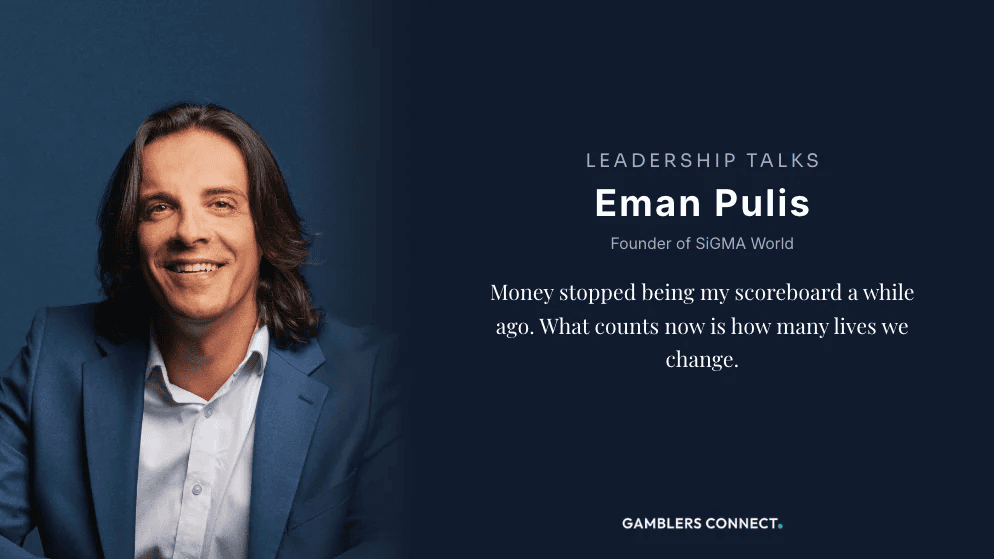
From the Campidoglio and Forbes Italia to the post-shutdown regrouping of Brazilian operators, Eman Pulis outlines why advancing regulated gaming defines SiGMA’s next decade.
Why Italy, and year two in Rome
You have explained the move away from Malta. What we have not seen answered is why Italy at all, rather than Spain, Portugal or Germany, given a regulated market with strict gambling advertising restrictions under the Dignity Decree and a digital segment that accounts for over 60% of gaming turnover. After one edition in Rome, would you make the same choice of country again, and what does Italy give SiGMA that another European capital could not?
EP: Italy is one of Europe’s largest land-based gaming markets, yet online accounts for only around a quarter of the total market, leaving enormous room for growth. Few markets can match that combination of established scale and untapped potential. Add to that Rome’s excellent international connectivity, and it makes a compelling choice for bringing the global industry together. That said, I certainly wouldn’t rule out another World Capital in 2030.
Why we are asking. Leaving Malta was widely covered, but committing to Italy, a market with severe advertising bans and an established online share, is counter-intuitive. Readers planning international travel and marketing budgets need to understand the strategic commercial upside of Rome over competing European capitals.
Getting between central Rome and Fiera Roma, around 40 minutes by taxi, was one of the most discussed practical aspects of last year’s edition, even with more than 30 shuttle buses across three routes and free metro tickets. What will delegates find different this November, and what else from year one has changed how the second edition is built?
EP: This year, we’re introducing a new section in our SiGMA Match app specifically for shuttles, with live updates and tracking, making it easier for delegates to see where their shuttle is, which route they need, and when the next service runs. More broadly, the first edition gave us a very clear understanding of how people actually move through the event and the city, what they need, where they need information, and when they need it. We’ve used those insights to build the second edition around a much more connected delegate experience, with clearer communication, better coordination, and a stronger focus on making the practical side of attending as seamless as possible.
We will have 60 shuttle buses this year, running across five routes, connecting the airport, hotel, and city with Fiera Roma between 7:00 and 19:00. Delegates will be able to use the transport section of the SiGMA Match app to find the nearest stop, check service info, and follow live updates. Additionally, a free shuttle will operate from the Fiera train station to the main entrance, for those choosing to travel from the City Center directly to the Fiera by train. We are also pleased to announce that for the first time, three well-known taxi companies will come together to coordinate a better service for delegates – a dedicated taxi rank will be located inside the venue. This means that approximately 4000 taxis will be on call during the event.
Why we are asking. Commute times and transit friction were the single biggest talking point among attendees in year one. Outlining concrete operational improvements gives delegates and first-time visitors the practical clarity they need before booking travel and accommodation.
Italy as a host
Italy awarded 52 new online concessions to 46 operators at €7 million each, effective 13 November 2025, and abolished the skin model that part of the market had operated through. Rome 2026 is the first SiGMA edition under that regime. How has the reset changed who exhibits and attends, and have you seen notable Italian names leave the market?
EP: Italy’s regulatory reset marked a significant shift for the industry. With every licensee now operating under its own licence, the market has a clearer and more stable foundation for future growth. There is a great deal the wider gaming industry can learn from Italy’s experience, particularly when it comes to navigating regulatory change and adapting to new market conditions.
Our show reflects this by giving licenced operators greater prominence and clearly identifying them on our website. This year, we are also introducing a dedicated Italian pavilion, led by SAPAR, with its own conference stage hosting discussions in both Italian and English.
We are expecting a strong Italian presence, both on the exhibition floor and across the conference programme. Adolfo Urso, Italy’s Minister of Enterprises and Made in Italy, is expected to attend the opening ceremony. At the same time, the Italy Stage programme will conclude on 5 November with an address by Rosaria Tassinari, a Member of the Italian Parliament who has also worked on AI regulation. Fabio Angeli Bufalini, Country Director of Stake Italy, will also contribute to a discussion on the country’s new online gaming licensing framework.
Visitors to Hall 5 will see major Italian industry names, including NOVOMATIC Italia, Lottomatica Servizi, Cristaltec, Stanleybet, Netwin and DomusBet. For us, local businesses, policymakers and institutions must have a prominent voice alongside international industry leaders. Bringing those perspectives together creates more meaningful conversations and ensures the event reflects both the opportunities and the realities of the market.
Why we are asking. A €7 million concession barrier reshaped the economics of Italian gaming overnight and eliminated white-label skin operators. How that structural culling translates to the exhibition floor is a commercial reality that affects every B2B supplier attending.
SiGMA has presented this edition at the Campidoglio with the city council and is partnering with Forbes Italia on Vision 2030 discussions and the Top 50 Regulated Gaming Italy list. That puts the industry in front of Italy’s wider political and business establishment. What shift are you trying to achieve in how Italy’s establishment views this sector, what does Rome gain from SiGMA beyond the headline €100 million economic impact, and how will you define long-term success in the Italian market?
EP: Our industry is often misunderstood outside the trade, and part of that is on us. So we launched this edition at the Campidoglio, and are working closely with Forbes Italia on Vision 2030 and the Top 50 Regulated Gaming Italy list. Both through the Forbes initiative and our new slogan, Advancing Regulated Gaming, we want to reinforce the importance of regulation and the need to recognise those who operate in compliance with it. I would rather talk openly with Italy’s institutions and business community than leave the conversation to others. Without dialogue, everyone loses, and when you squeeze a legal market, players move to illegal ones.
The first edition brought close to €100 million into the local economy, and the benefits reach well beyond our halls: hotels, restaurants, transport, logistics, events and services. This year, we expect more than 30,000 delegates, around 85% of whom will be from abroad. For me, success in Italy means that when people ask where the industry talks about regulated gaming, the answer is Rome.
Why we are asking. Trade summits typically remain insulated within trade media. Taking the event into city hall and partnering with mainstream financial media is a deliberate reputational play that requires on-the-record strategic intent.
The show floor and portfolio
SiGMA now runs eight summits a year across Europe, the Americas, Asia and Africa, and increasingly combines business networking with entertainment, sport, affiliate competitions and investment. With exhibitors increasingly having to allocate marketing budgets across a crowded event calendar, how do you keep regional summits essential rather than competing with the flagship, and what does a major B2B gaming event need to offer in 2026 that it did not need to offer five years ago?
EP: Across our eight summits and around 30 side events, we bring together approximately 80,000 industry professionals every year. What makes our regional summits distinctive is their strong local focus. We have dedicated teams on the ground who understand the markets they operate in, allowing us to develop carefully curated programmes that speak directly to each region’s priorities, challenges and opportunities. Language is an important part of that approach, whether through bilingual publications or conference discussions delivered in multiple languages.
At the same time, one of SiGMA’s greatest strengths is its ability to bring different sectors together, creating opportunities for collaboration that might not otherwise happen. Rome is a perfect example of this, bringing four distinct communities under one roof: SiGMA World for gaming, AIBC for AI and blockchain, FX World for financial markets, and AGS for affiliates. Each has its own dedicated conference programme and exhibition space, while benefiting from the connections and opportunities created by the wider event.
With more than 1,200 sponsors and exhibitors, three startup pitch competitions and 12 workshops, the scale is considerable. But what really matters is the quality of the connections we create, bringing the right people, ideas and industries together in ways that can lead to meaningful business opportunities.
Why we are asking. A crowded international calendar puts intense pressure on fixed corporate marketing budgets. Explaining the distinct commercial positioning between regional shows and the European flagship helps exhibitors justify multishow commitments.
Regulators and global shifts
Sixty-five regulators are expected in Rome. Beyond panels and appearances, what concrete regulatory dialogue or cross-border cooperation has SiGMA helped facilitate that would be difficult to achieve through conventional domestic regulatory channels, and can you point to an example where those conversations led to a tangible outcome?
EP: About sixty-five regulators from different continents are coming to Rome, under this year’s theme of advancing regulated gaming, and what they get from SiGMA goes well beyond attendance figures. Our panels, workshops and roundtables put key regulatory questions on a public stage, where regulators, operators and suppliers can exchange views openly and take questions straight from the audience. The workshops run for three days with bodies such as IBIA, IMGL, IAGA, CIBELAE, and the Gaming Regulators Africa Forum, and authorities from Spain, Cyprus, and Denmark are on the stages.
Just as much happens offstage, because SiGMA offers a neutral international platform where we regularly connect regulators with industry participants, bring public- and private-sector people into the same conversation, and help policymakers, regulators, and industry associations find common ground on matters of shared interest. These rooms produce conversation and shared research.
We are also seeing our summits increasingly align with important regulatory developments worldwide. When we held our first event in Dubai in 2021, the UAE was beginning to reshape its approach to gaming regulation and would go on to establish a federal commercial gaming regulator two years later. Last December, SiGMA South Asia made its debut in Colombo on the same day Sri Lanka introduced its new Gambling Regulatory Authority. These developments reflect how closely the industry’s growth is becoming intertwined with the evolution of regulatory frameworks.
That relationship is also reflected in the growing presence of regulators at our events. In March, the Gaming Regulators Africa Forum (GRAF) chose SiGMA Africa in Cape Town to host its regulatory forum, while AIEJA selected the inaugural SiGMA North America event in Mexico as the setting for its AGM later this year.
For us, these are important steps towards greater cooperation, knowledge-sharing and regulatory dialogue across markets. Full harmonisation may take time, but there is enormous value in bringing regulators together to exchange experiences, share intelligence and learn from approaches beyond their own jurisdictions. These are conversations that can be difficult to facilitate through domestic channels alone.
Why we are asking. Headline numbers of regulator attendees are common across major conferences. Readers in compliance and policy want to see tangible evidence that these gatherings produce genuine cross-border outcomes rather than mere stage appearances.
Brazil has suspended online betting and casino activity, with the measure announced on 25 September and licensed sites due to go dark around 6 October, less than two years after the regulated market opened and after operators made substantial licence investments. Rome opens shortly after the shutdown. Does that make it an important place for affected operators and suppliers to regroup and reassess, and what broader lesson does Brazil offer the international industry?
EP: Every market goes through periods of instability – but resilience comes from being flexible and open to change. I remain confident in the region’s future and firmly believe it will emerge from these challenges stronger and better positioned for growth.
Rome provides an ideal opportunity for operators and suppliers to come together, exchange perspectives, and begin shaping conversations about what comes next. Brazil will also be the focus of a dedicated workshop taking place on the 4th. Led by BiS, the workshop reinforces our continued commitment to the region and its long-term potential.
Why we are asking. Opening just weeks after Brazil’s abrupt market suspension makes Rome the first major global forum where affected license holders and suppliers convene to reassess their LatAm exposure.
The group after Rome
SiGMA has acquired its own headquarters in Limassol as a permanent home for the team, while continuing to expand offices in Malta, Manila, São Paulo, Yerevan, and Belgrade. In an industry that has largely normalized remote setups, what is your executive stance on remote work versus physical presence, how does SiGMA’s internal policy balance the two across a global workforce, and which of these locations anchors the group’s next phase of growth?
EP: I value the flexibility of remote work, but for me nothing replaces meeting people in person. In our business, it goes friendship first, then trust, and then the business follows, and an office gives you that every day. More than 450 of us work across six offices: Malta, Cyprus, the Philippines, Brazil, Armenia and Serbia. Our brands have grown from these teams, too. FX.world is based in Cyprus, while iGaming Academy is based in Malta. Despite our different cultures and the different work we do, we continue to learn from one another and build a deeper understanding of each other every day. That diversity and willingness to connect are among our greatest strengths.
Why we are asking. Purchasing commercial headquarters in Limassol while expanding six regional hubs runs counter to the digital-first pivot seen across tech and media. How an executive manages operational culture across 450 people speaks directly to company longevity.
SiGMA has grown from an events company into an ecosystem spanning events, media, SiGMA Play, affiliate businesses, brokerage and venture investment through Ikigai Ventures, with more than 450 people. How do these businesses fit together today, and which verticals are currently driving expansion across an organization built to withstand market volatility?
EP: COVID hit us hard, but it also became our biggest turning point. It forced us to adapt, rethink our priorities, and take the business in a bold new direction. From that shift came our first international event in Dubai, Ikigai Ventures, and the SiGMA Foundation.
Today, the group is built around several core pillars: Events, SiGMA Play, iGaming Academy, Ikigai Ventures, and the SiGMA Foundation. Together, they allow us to reach the key audiences at the heart of Vision 2030: operators and suppliers, players, and governments and regulators, while expanding our work across media, education, and advisory services.
The best example of where we’re heading is SiGMA World in Rome. Gaming is no longer an industry operating in isolation. In Rome, it sits alongside AI, blockchain, financial markets, and affiliate marketing, with startups pitching to investors just a few steps away from operators and regulators. That same vision drives our investment fund, which backs opportunities in areas such as esports, fintech, and AI.
Rome brings all these worlds together.
Why we are asking. Moving beyond events into lead generation, training, and venture capital fundamentally changes the group’s risk profile. Outlining how these subsidiaries interact provides a clear picture of the company’s long-term business model.
You have said SiGMA is not for sale until the job is done, and Vision 2030 describes that job as building the infrastructure of the industry. Four years out, what specific milestones would tell you it is done, and is there anything in the group today that you would build differently if you were starting again?
EP: The goal is to make SiGMA the infrastructure that connects the entire industry, built around three pillars. B2B is where it all began, bringing together operators and suppliers who have come to trust us as a platform for meaningful connections and business opportunities. B2C is about reaching players and making SiGMA a trusted source of honest information, independent reviews, and guidance. B2G is about working with governments and regulators, particularly in markets that have yet to establish a regulatory framework. Our door is open because responsible regulation is essential for sustainable growth.
By 2030, I want SiGMA to be the place where all three worlds come together, with trust and transparency at the centre of everything we do. It’s an ambitious vision, but I’ve always believed that big goals are achieved through small, consistent wins. That’s what keeps me focused along the way.
Why we are asking. Founders frequently declare their company is not for sale, but rarely define what completion looks like. Readers following SiGMA’s corporate trajectory need clear criteria for what “Vision 2030” actually represents in operational terms.
The founder, and the last one
You are known across the industry for answering messages yourself and staying accessible well beyond SiGMA’s largest clients and partners. With more than 450 people, eight summits a year and Emily Micallef running the business as CEO, is that openness a deliberate principle, and how do you manage to equally divide your time and attention to everyone the same way you did when you previously served as a CEO, and now as Founder of SiGMA?
EP: In my experience, people do business with people, so I need to be reachable. For me, accessibility is simply part of the work. With more than four hundred people, it only works because decisions are spread across the team: I want people to feel it is fine to make mistakes and take calculated risks, and when they come to me with a problem, I ask them to bring a solution too.
Why we are asking. At enterprise scale, most founders insulate themselves behind layers of administration. The direct personal availability on messaging apps is widely cited across the sector, and readers want to know how that operational habit survives corporate expansion.
The Foundation has built schools in Ethiopia, Uganda and Kenya, runs a youth sports school in Brazil with Centurion, and has more projects in the pipeline. On its page you write that if you can help lift a million people out of poverty, you will have become a true millionaire. What does the Foundation mean to you personally, and how do you measure meaningful progress toward that ambition?
EP: Money stopped being my scoreboard a while ago. What counts now is how many lives we change. If a million people can be lifted out of poverty because of the Foundation, I will consider myself a millionaire in a way that actually matters. In addition to fundraising from our auctions and other side events, ticket proceeds from our summits also fund the Foundation, and I judge it by what is actually built and who uses it: schools, a hospital extension, community centres, and a sports centre. The 3-in-1 school in Bonga, Ethiopia, teaches around 1,000 students a year, and by our latest count the Foundation’s work has reached almost 28,000 lives.
Why we are asking. The Foundation operates outside the commercial event business, and the target was framed in the first person. This moves the conversation from corporate performance to personal ethical responsibility.
A personal one from our side. SiGMA backed Gamblers Connect when we were starting out in 2021 and has supported our work since. You do something similar for affiliates through the Affiliate Retreats, the Startup Pitch and free entry for vetted affiliates at the summits. Why does a group of SiGMA’s size keep investing time in affiliates, start-ups and independent media that cannot yet buy a stand, and what do you look for when deciding who to back early?
EP: I remember starting out. When I began, plenty of people said there was no room for another event format, and I wish I had found mentors sooner. When someone gives you a stage before you can pay for it, you never forget it. So we keep making room for affiliates, start-ups, and independent media, with complimentary passes for affiliates and a stage for start-ups through the Startup Pitch. Small wins add up, and many of our earliest clients are still with us, which tells me this kind of support pays off.
Why we are asking. Independent media and emerging affiliates rarely receive institutional support from major event brands before they reach commercial scale. We disclose our own early relationship to ask a broader business question about why nurturing the grassroots tier of the industry pays off long term.
Building and scaling a venture from an island startup into an international ecosystem across four continents requires a distinct mental model. If you had to recommend one book, or one core framework, that fundamentally shaped your philosophy on leadership, resilience, or business building, what would it be, and why should the next generation of founders read it?
EP: If I had to pick one framework, it would be the concept of pursuing ikigai: what you are good at, what pays, what you love, and what is good for society. In our case, the Foundation covers that last part, and our venture fund carries the name. My advice to young founders is to look for the place where those four meet, because that is where success tends to follow.
Why we are asking. We close our leadership interviews by asking for the practical frameworks that guide decision-making under uncertainty. Founders and operators reading this look for tangible principles that survive real-world corporate scaling.