

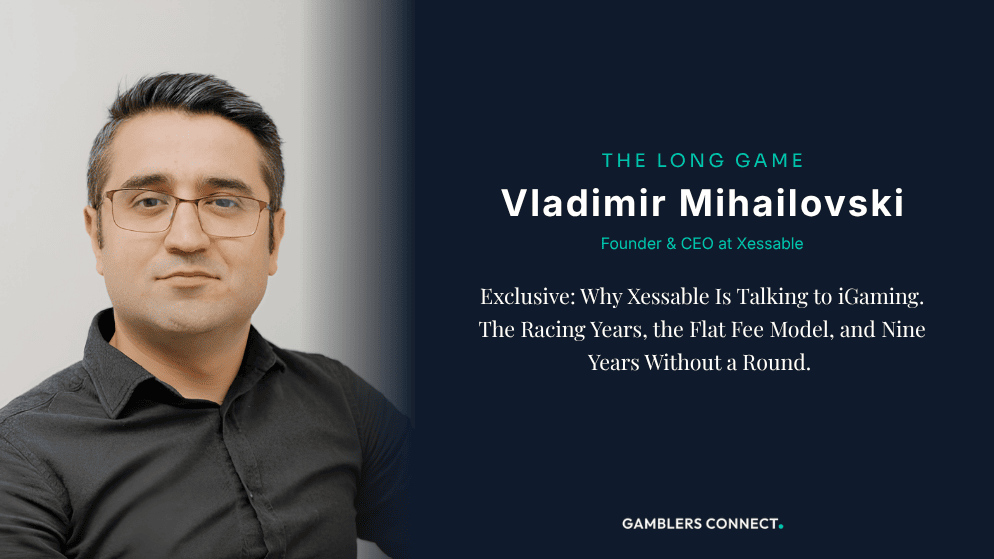
Nine years, one client from the earliest months, and no outside money. A founder interview about building slowly
Before any of it
Before launching Xessable in 2017, you built your career across roles at Datasoft.mk, Nextsense, and Horeko. What prompted the transition from engineer and architect to founder, and what was the missing piece in your biography that pushed you to make that leap?
VM: “I can do this better” – that was my North star. And it came naturally. I never envisioned myself as a Founder, but seeing how others are doing it and knowing that I can do better, was probably the main push towards this transition.
Why we are asking. Moving from a technical role to leading a company is the central turning point in your professional journey, and readers will want to understand the exact catalyst behind that shift.
The founders’ note on your own site says you worked in outsourcing companies early in your careers, and that hardships there gave you insight into how to do things differently. What were those hardships?
VM: Lack of transparency, lack of open communication, and mostly how companies treated their own people. I saw amazing professionals leaving their companies because they were not even heard, or given the freedom to share their ideas, or not given the right opportunities to grow. I always go by the famous quote by Richard Branson: “Train people well enough so they can leave, treat them well enough so they don’t want to”.
Why we are asking. That is the closest thing to an origin story you have published anywhere, and it is one sentence. It clearly points at something specific and readers will want to know what.
Starting it
That note is signed from your founders, plural. Who started Xessable with you, and what is their role today?
VM: Xessable had 4 founders, two Dutch guys and two Macedonians. We shared the same vision from day one of building the best place to work where we’ll be delivering quality without compromises to our clients. Unfortunately we separated our ways out over the first 6 years of the company for different reasons, leaving me being the sole owner of the company for the last 3 years. Even today, I’m in a good relationship with all of them, which for me personally is one of the biggest successes.
Why we are asking. Founder interviews tend to flatten a team into one person. If this was not a solo build we would rather say so properly.
You built a Dutch company and a Macedonian company rather than one entity. Practically, what sits in Utrecht and what sits in Skopje, and why structure it that way from the start?
VM: Initially we decided to have entities in the Netherlands and Macedonia because we had people representatives in these two countries. From day one, the Dutch entity is the sales and business development center, and the Macedonian entity is the engine, the software development center. The Dutch entity as a EU company gives guarantees by default to our partners within EU, but also easier access to the Benelux region (something we needed from the start), and our Macedonian entity gives us a lot of advantages as access to reliable, high-quality talent pool that provides cost-efficient, long-years support and commitment to our clients.
Why we are asking. The dual structure is unusual at your size and it is the operational heart of how the business actually runs. It is also the decision that shaped everything after it.
The nine years
Horeko appears to have been a client since the company’s earliest months and still is today. How did that relationship start, and what has kept it alive for nine years when most agency relationships last months?
VM: Horeko was the “pilot project” of the Xessable setup :). We’ve already tested the initial idea with Horeko even before we started Xessable. I would say the open communication and transparency we had from day one, kept this relation all these years. At the start you need to gain trust, and you gain trust by keeping your word, by delivering on time and most importantly by saying and fighting for what you think it’s best for the product (don’t be the nodding guy). You need years to build trust, but seconds to lose it.
Why we are asking. A client review dates the engagement to January 2017, which is around the time the company was being set up, so we would rather you told us the actual sequence than have us guess. It is also the practical version of the long game, told through a real relationship rather than a philosophy.
There are no funding rounds on record for Xessable. Have you ever taken outside investment, and if not, was that a decision or a circumstance?
VM: Xessable is a bootstrapped company. It became profitable from year 2 and stayed like that all these years. We had an opportunity for a passive investment a few years ago, but I decided to skip that because it was not the best decision for the company at that time.
Why we are asking. We can see no rounds, but we can also see a second shareholder on the Macedonian filing that we could not identify, so we would rather ask than assume. Bootstrapping also gets described afterwards as a principle when it began as a lack of options, and founders reading this will find the honest version more useful.
Your model is a flat outsourcing fee independent of the engineer’s salary. Most of the industry prices on a margin over cost. Why did you build it the other way, and what does it cost you?
VM: The reason behind the flat outsourcing fee was to define a margin that will cover our expenses and make us some profit on the top of it. We always wanted to transparently discuss it with our clients, so they are aware of what they are paying for. It was independent of the developers salary, which means if they were happy with someone’s performance they can increase their salary as much as they care and we don’t make a cent out of that, compared with other companies where we saw violating this a lot, especially from top performers. That is why we have an average employee churn rate of 5%, which is almost twice lower than the European average employee churn rate.
Why we are asking. It is the most distinctive commercial decision Xessable has made and your own site states it plainly. Asking what it costs rather than what it gains is what stops the answer sounding like a sales line.
Where it is now
The Macedonian entity filed broadly flat revenue across 2024 and 2025, with profit down in the second year. That is only one side of a two-country business. What was actually happening across the group in that period?
VM: I would say the profit drop in the second year relates with the investments we did in up-skilling our people in the area of AI, and the collaborations we did with external companies that helped us in the area of marketing and executing our GTM strategy. We already see some results of that investment in 2026, but I can talk more about it when we’ll get the financial reports for 2026 :).
Why we are asking. The Macedonian filings are public, so the question will occur to anyone who looks them up. They also only cover one of your two entities, which is exactly why we would rather you gave us the full picture than have a reader draw conclusions from half of it.
You have moved from Outsourcing Done Properly to Software That Moves, and added an AI position. Is AI a delivery efficiency story for you, or a product story?
VM: Nice catch on the wording. Yes, we’ve changed the content a little bit on the website, but not to the extent we wanted to (it’s pending approval from me :)). We’ve fully migrated to AI driven development for the last year and a half, and successfully implemented it for most of our clients. Our focus is fully on AI now and we slightly run away from the outsourcing part, because it’s accepted as a fire and forget model, or body leasing, which we never did, even from day one. But we’re too busy with work nowadays, I hope we’ll find time to change the content on our website to fully present what we do these days.
Why we are asking. The two mean very different things commercially, and the rebrand is recent enough that nobody outside the company knows which one it is.
Nine years in, with thirty-one people and no outside money, what is the decision in front of you now that was not in front of you three years ago?
VM: Expansion, growth and how to achieve it. Doing it alone, merging with other companies, allowing investors to join, if so what type of investors … lots of decisions, but all focused on one thing, bringing the company to the next level.
Why we are asking. This is the hinge of the piece. Every bootstrapped company reaches a point where staying the same size is itself a choice. We are interested in what that choice looks like from where you are sitting.
This audience
You have joined the Gamblers Connect Contributors Program, but Xessable is not a gambling supplier and has no named clients in the sector. What do you want to say to this audience?
VM: A very small circle of people know that the first three years of my professional experience I’ve been working within the gambling / i-gaming sector, building software products for one of the biggest gambling companies for greyhound, thoroughbred and harness racing in Australia.
The iGaming industry is full of challenges from regulations, frauds, security issues, time critical issues that makes a perfect candidate for our company at this moment. We’ve already covered all these topics in different industries and we’re ready to help companies within the iGaming industry tackle these challenges together.
Why we are asking. Our readers are operators, suppliers and founders in iGaming. Rather than imply a connection that is not there, we would rather you set out in your own words what you think you can offer them.
Last one
Across nine years, what have you personally owned that nobody else could have done, and what did you get wrong that you would do differently?
VM: Over these nine years, I personally grew a lot. I can say I’ve had the chance to cover all C-level positions within the company, because when the company is small you don’t have the privilege to hire a person for each. So I would say being the buffer between our clients and our professionals and making it work smoothly is one of the best skills I gained.
I’ve made plenty of mistakes on this journey, and if I need to choose one it would be not hiring a dedicated sales person from day one and investing more into marketing. For the first 5 years we’ve been doing well only by doing sales by word-of-mouth and minimal investments into marketing. From day one our vision was quality over quantity, and we were happy with the steady growth, but building a stable sales team within the company I would say is crucial for every company for a stable future. Securing your revenue stream is most important because “Cash is the king, but Revenue is the king’s knight”!
Why we are asking. We close every interview by asking what the person is accountable for. The second half is the part readers remember.