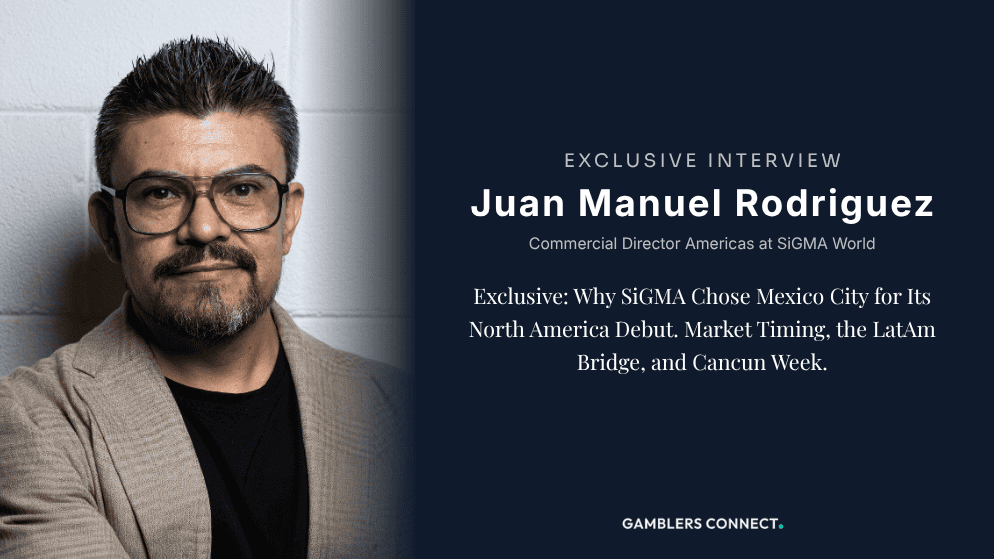
A written interview for Juan Manuel Rodriguez Ospina on the inaugural SiGMA North America summit at Centro Banamex, Mexico City, 1 to 3 September 2026, covering the market thesis behind the launch, the Spanish-speaking continent strategy, the Cancun week that follows it, and what a debut edition has to prove.
THE DECISION: WHY MEXICO, AND WHY NOW
SiGMA has run summits across Europe, Asia, Africa and South America for years. What specifically made Mexico City the right entry point for North America rather than Las Vegas, Toronto or Miami?
Context The SiGMA North America page frames Mexico as both Latin America’s second largest economy and a gateway to the broader North American region. We want the reasoning in your words, including what was ruled out.
JMR: Mexico City was the right entry point because it sits at a unique intersection between Latin America and North America. Mexico is the second-largest economy in Latin America, has an established land-based gaming industry, a growing online market and strong commercial links with the United States and the wider region. We also felt the timing was right. The market is attracting growing international attention, while operators and suppliers are seeking a better understanding of the opportunities on the ground. We did not want to wait until the market was completely mature. SiGMA has always sought to enter markets with momentum, where bringing the international industry together can help accelerate development. Las Vegas, Miami, and Toronto are obviously major markets, but Mexico City offers something different. It allows us to build a bridge between the Spanish-speaking markets of Latin America and the broader North American ecosystem.
The event page says Mexico is piping hot right now. What does that phrase actually mean in numbers on your side, and what were you seeing in the market that told you the timing was right for 2026 rather than 2024 or 2028?
Context The public copy cites Mexico’s online gambling market more than doubling from 1.75 billion US dollars in 2023 to a projected 3.53 billion by 2030. We would like to know which indicators you personally watched.
JMR: The headline numbers certainly support the opportunity. SiGMA’s event research indicates that Mexico’s online gambling market is growing from around USD 1.75 billion in 2023 to a projected USD 3.53 billion by 2030. The online casino segment is also forecast to grow strongly, while the land-based sector has recorded 2.8% growth since 2023. Mexico City alone has 96 casinos according to the market data used for the summit. But numbers are only part of the picture. What I was seeing commercially was increasing interest from international companies that wanted to better understand Mexico, establish local relationships, and identify where the next opportunities would come from. The timing is therefore about market readiness rather than simply market size. We felt that 2026 gave us the right combination of demand, international interest, local partnerships and regulatory conversation. Waiting until 2028 would mean waiting while the market and the relationships around it continue to develop without us.
Mexico City alone has 96 casinos, and the land based sector grew 2.8 percent from 2023. How much of the SiGMA North America thesis rests on the land based estate versus the online opportunity?
Context Most iGaming events lean online. Mexico has a substantial land based footprint, and the balance you strike will shape the exhibitor mix and the conference agenda.
JMR: Both are important. One of Mexico’s strengths is precisely that it does not fit neatly into an online-only narrative. There is a substantial established land-based industry, while online gaming and digital technologies are creating additional opportunities. That balance is reflected in the people we want in the room. Operators, technology providers, payment companies, affiliates, regulators, and investors all have different priorities, and the event needs to reflect the full ecosystem rather than focus on a single vertical. For me, the opportunity is where those two worlds meet. Land-based operators are looking at digital transformation, online acquisition, payments, data and technology, while digital companies need to understand the established market and its stakeholders. That creates much more interesting conversations than treating online and land-based as completely separate industries.
THE SPANISH SPEAKING CONTINENT STRATEGY
The positioning describes SiGMA North America as spotlighting the Spanish-speaking market across the continent, with SiGMA South America in Brazil as its counterpart, scheduled six months apart. Why split the Americas by language rather than by geography?
Context: This is the single most distinctive structural decision in the launch and it deserves to be explained properly rather than left as a line on a landing page.
JMR: Language is a major commercial and cultural connector, particularly in Latin America. Mexico and the wider Spanish-speaking market have a very different ecosystem from Brazil, which operates in Portuguese and has its own scale, regulatory environment and business culture. The strategy is not about separating the Americas. It is about creating more relevant platforms for different markets and then connecting them through the wider SiGMA network. SiGMA North America provides a platform centred on Mexico and the Spanish-speaking markets, while SiGMA South America, in Brazil, provides a dedicated platform for the Portuguese-speaking market. The events are also spaced apart, giving companies the opportunity to engage with both markets without having to choose between them.
Where do the United States and Canada sit within a summit called North America, held in Mexico City and centered on the Spanish-speaking market?
Context: The name says North America. The positioning says Spanish-speaking. Readers will want that reconciled.
JMR: They are an important part of the strategy. North America should not be interpreted as meaning Mexico in isolation. We see Mexico City as a meeting point between the Spanish-speaking markets of Latin America and companies operating across the United States, Canada and the rest of the world. For US and Canadian companies, Mexico offers an opportunity to connect with a market that has strong regional influence and direct commercial ties to North America. At the same time, Latin American companies can use the event to connect with international suppliers, operators, investors and decision-makers. The ambition is therefore to create a genuinely international event, with Mexico as its strategic base.
THE NUMBERS AND WHAT A DEBUT HAS TO PROVE
The event page projects 4,000 delegates, 1,000 operators, 850 affiliates, 150 plus speakers, 150 plus exhibitors and sponsors, and 46 percent C level attendance. For a first edition, which of those numbers is the one you would be most disappointed to miss?
Context Forecast numbers for an inaugural event are the hardest to hit. Naming the one that matters most tells readers what success actually looks like to you.
JMR: For me, it is the quality of the audience rather than simply the overall delegate number. The target of 4,000 delegates is ambitious, but the real value for an exhibitor comes from having the right people in the room. That is why the operator and C-level figures are particularly important. We are targeting 1,000 operators and 46% C-level attendance because those are the people who can make decisions, create partnerships and drive business forward. A high footfall is valuable, but a smaller audience of highly relevant decision-makers can ultimately deliver much greater commercial value. That is the standard we are setting for the inaugural edition.
How will you measure whether the inaugural edition worked, and when will you know? Is it rebookings signed on site, exhibitor satisfaction, deal volume, or something else?
Context SiGMA leadership has said elsewhere that exhibitors rebooking before a summit closes is one of the strongest signals. We want to know if the same test applies to a debut.
JMR: There are several measures, but one of the strongest indicators will be whether our exhibitors and sponsors want to come back. We will look at attendee and exhibitor feedback, meeting quality, operator participation, the level of senior decision-makers, and the commercial conversations generated during the summit. Rebookings are particularly important because they show that companies believe the event delivered tangible value. We also need to recognise that not every business relationship converts immediately. Some conversations at the summit may lead to partnerships or deals months later. So we will measure the immediate results while also examining the longer-term relationships formed through the event.
THE CANCUN WEEK AND WORKING WITH OTHER ORGANISERS
SiGMA North America in Mexico City on 1 to 3 September runs straight into Affiliate Retreat by SiGMA in Cancun on 4 to 6 September and Affiliate World by iStack in Cancun on 7 to 8 September. Was that eight-day sequence designed as a single trip for delegates?
Context Three events across two cities inside eight days is either a deliberate super week or a scheduling coincidence. Worth putting on the record.
JMR: Absolutely. From a delegate perspective, the timing presents a compelling opportunity to make a single trip to Mexico and access several industry environments. SiGMA North America takes place in Mexico City from 1 to 3 September, followed by the SiGMA Affiliate Retreat in Cancun from 4 to 6 September and Affiliate World by iStack from 7 to 8 September. For affiliates in particular, that creates a full week of business opportunities. They can start with the broader industry ecosystem in Mexico City, move into a more focused networking environment at the retreat and then continue into another major affiliate event in Cancun. It makes the trip more efficient and gives international delegates a much stronger reason to spend an extended period in Mexico.
YOUR OWN BRIEF, AND THE MARKET AHEAD
Describe your own role in getting SiGMA North America off the ground. What have you personally owned across the last twelve months?
Context The interview is with you, not with the group. Readers want to know whose decisions these were.
JMR: As Senior Sales Manager for LATAM, my role has been focused heavily on building the commercial foundations of the event. That means engaging with operators, suppliers, affiliates, and other stakeholders across the region, understanding their priorities, and demonstrating how SiGMA North America can create value for their businesses. A major part of that has been relationship-building. Entering a new market is not simply about selling exhibition space. You have to understand the ecosystem, identify the right stakeholders and build trust over time. The last twelve months have therefore been about building that network and ensuring the event reflects what the market actually needs. When people arrive in Mexico City in September, they will see the summit itself, but behind it is a year of conversations, meetings and relationship-building across LATAM.
What is the most common misconception you encounter from operators or suppliers outside the region when you talk to them about Mexico or Latin America?
Context Correcting a misconception on the record is one of the most useful things an interview can do.
JMR: The biggest misconception is that Latin America is one market. It is not. Every country has its own regulatory environment, consumer behaviour, payment preferences, commercial culture and business dynamics. What works in Brazil may not work in Mexico, and the same applies when comparing Mexico with Colombia, Peru or other markets. Another misconception is that companies can afford to wait until the region is fully mature before entering. By that point, many of the strongest relationships and opportunities may already have been established. The companies that succeed in Latin America tend to be those that take the time to understand each market and build genuine local relationships. That is exactly the kind of connectivity we want SiGMA North America to facilitate.